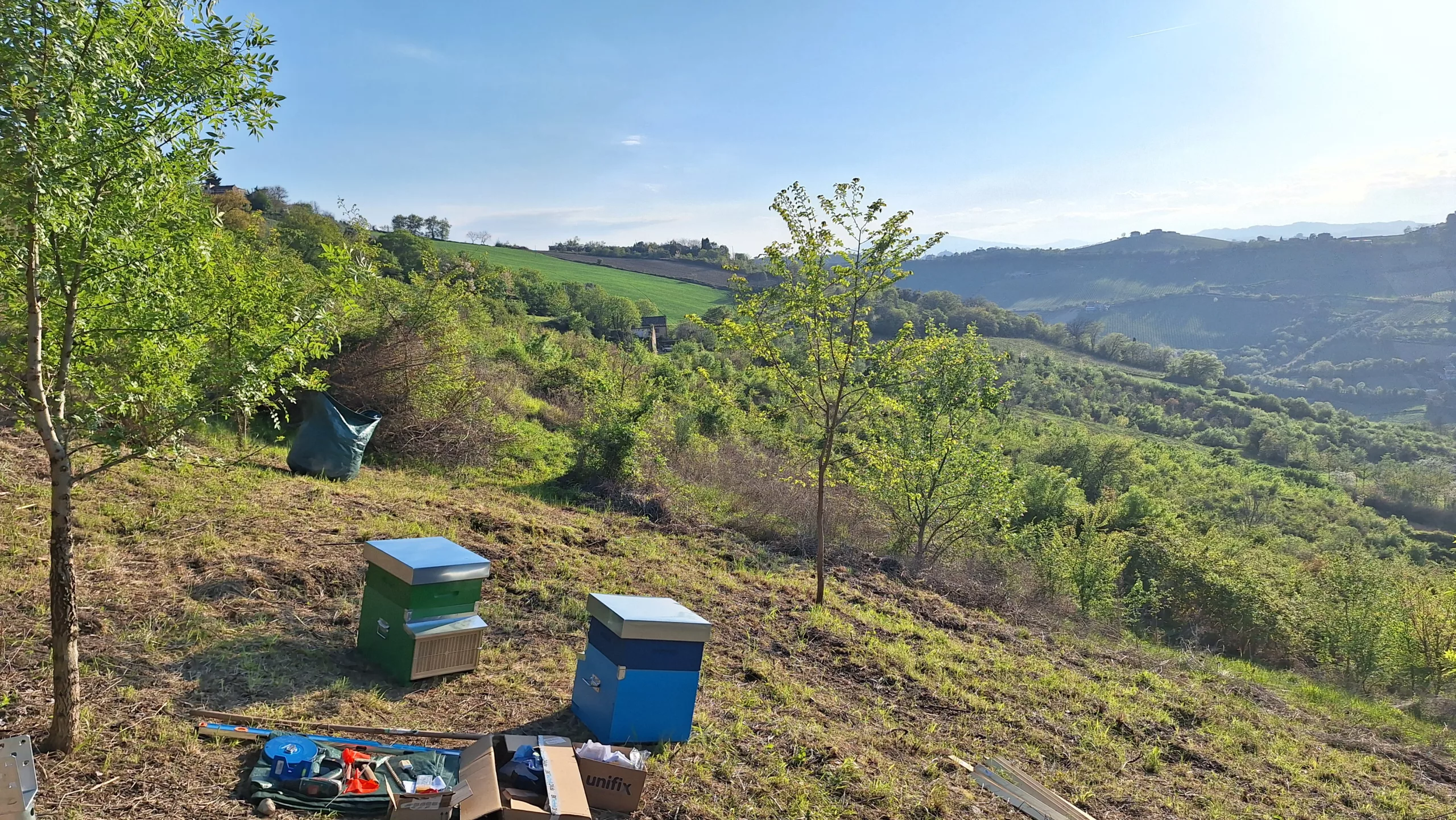
How do you choose the location for your first beehive on a slope?
When we first looked at the map of our land, we identified a few logical spots for our apiary. However, .. we quickly learned that there is a significant difference between a theoretical “good spot” on a paper map and the practical reality of managing hives on a steep incline.
We didn’t spend months wandering the ridge; we started with a general area and then circled it on foot to ensure our plan met the two most important criteria for any hillside homestead: access and protection.
Easy access
One of the first things you learn in beekeeping is that everything is heavy. A single melario (honey super) full of honey can weigh 15 to 20 kilos. Carrying those up or down a steep, overgrown slope in the heat of a Mediterranean summer is not something you want to do more than once.
Logistics therefore became an important filter. We needed a site that was close enough to our central working area for easy monitoring, but with a path that allowed us to transport equipment without fighting the gravity of the hill. We weren’t looking for a wild location; we were looking for a manageable one where we could actually do the work.
On the other hand, we did not want the access to be too easy. We expect a lot of visitors, including children, and we want our bees to enjoy their silence. Also, when we got our Italian bees we were told they are not friendly. The apis mellifera ligustica (Italian bee) is not comparable to a buckfast bee, used by most beekeepers in The Netherlands, Belgium or the UK.
At the end, the location we decided upon is still a good 5-minutes walk from our main house.
The Tramontana
According to us, our hill is the most beautiful place to be. While coping with the heat is our biggest concern related to the bees, sometimes the region is facing a cold northern wind. This Tramontana is a welcome cool down for us, but not for the little ones. Therefore, we chose a spot where the natural curve of the hill provides a buffer, protecting the colony from the harshest gusts.
The Southwest flight path
The natural shape of the hill dictated the final design. In a flat field, you just set up your stands and start working. On a slope, you have to engineer your workspace.
While southeast is often cited as the perfect orientation for bees to catch the morning sun, the shape of our hill simply forces us to the southwest. This gives the bees a magnificent, unobstructed flight route straight into the valley below.
We realized early on that we needed to create a horizontal plateau. This isn’t just for the stability of the hives; it’s for our own safety. During a hive inspection, you need to be able to focus entirely on the bees without worrying about your footing or sliding down the ridge.
Because a southwest position can get quite intense in the afternoon, we had to think about climate control. Therefore, our horizontas plateau features simple wooden beams covered with plants at the back, sides and roof. This construction give the bees shade, while they still allow for a breeze to pass through, too. We hope that this combination helps in keeping the internal temperature of the hives stable when the sun is at its peak.